Custom Tooling Solutions for Box Parts, Square Tubes, and Deep Cavity Bending
Why Does Press Brake Box Bending Cause Interference?
Press brake box bending is different from ordinary straight-line bending. A normal bend usually only forms one open angle, while box bending requires multiple sides to be formed continuously. After each bend, the spatial position of the workpiece changes.
The already-formed flanges need room to swing during bending, but a standard straight punch does not provide enough clearance. Similarly, when forming square tubes or closed sections on a press brake, a dedicated square tube bending die is needed to support the tube wall and control springback.
To solve these problems, three tooling solutions are usually required: gooseneck punch, segmented tooling, and custom tooling designed according to the drawing.
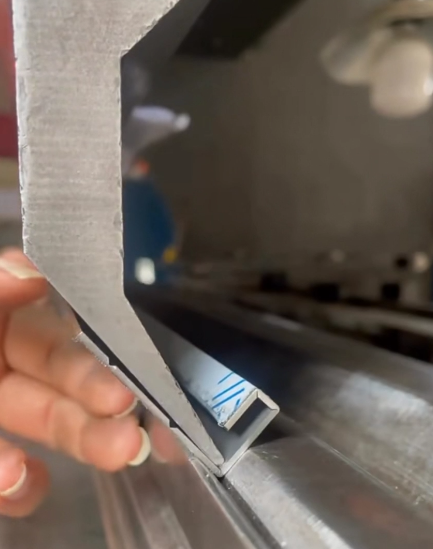
Understand the Special Tooling Family for Box Bending
1. Gooseneck Punch
A gooseneck punch has a clearance cavity in the middle of the punch body, also called throat depth. This clearance allows the already-formed return flange to move into the open space at the bottom of the stroke. It is a standard solution for the third and fourth bends of box-shaped parts.
The maximum box height depends on the throat depth:
Maximum box height H ≈ throat depth − 2 × sheet thickness − inside radius
For example, with a 50 mm throat depth, 2 mm sheet thickness, and 2 mm inside radius, the theoretical maximum box height is about 44 mm.
2. Segmented Tooling and Horn Punch
The inside dimensions of box parts are different, so a full-length punch may not fit. Segmented press brake tooling divides the upper punch into precision-ground sections, usually from 10 mm to 100 mm, allowing operators to combine the tooling according to the internal box size.
A horn punch with corner relief can be added at the end to let adjacent side walls pass through without scratching.
A simple way to judge whether a gooseneck punch is needed: once the flange crosses the centerline of the upper punch, a gooseneck punch is required. If the flange still has more than 10-15 mm clearance from the punch body, many standard punch profiles can still be used.
3. Square Tube Bending Die
Square tubes and rectangular tubes cannot simply be placed into a standard V die. Unlike flat sheet metal, the tube wall has no lateral support. Once pressed, the tube may collapse, the inner wall may wrinkle, and springback may become difficult to control.
A square tube bending die is designed with a dedicated forming groove according to the tube section. It can also work with internal supports or segmented pads to support the tube wall, helping control collapse, wrinkling, and springback.
Why Do the Third and Fourth Bends of Box Parts Hit the Tool?
1. Mechanism: Inward Swing Around 45 Degrees
When bending the third side, the return flanges from the first two bends rotate with the bending angle. Around 45 degrees, they swing inward to their maximum distance.
For example, a 6-inch-deep box may swing inward by about 4.2 inches. A standard straight punch is wider at the upper body and narrower at the tip, like a wedge. At this position, the return flange may hit the punch body directly.
The result can be sudden tonnage increase, ram jamming, part damage, and scrap.
2. Solutions
Use a gooseneck punch: the punch body has a clearance cavity, allowing the return flange to pass through the throat area and avoid interference.
Bend the shortest flange last: leaving the shortest flange for the final bend reduces swing distance.
Simulate before production: cut the finished profile from cardboard and move it around the gooseneck punch to test the bending sequence. The return flange must be able to slide freely into the throat. CAD interference checking can also be done using the punch DXF profile and intermediate bending angles.
Use segmented tooling and horn punches: precision-ground segments can be combined according to the internal box length, while the horn punch provides clearance for side walls.
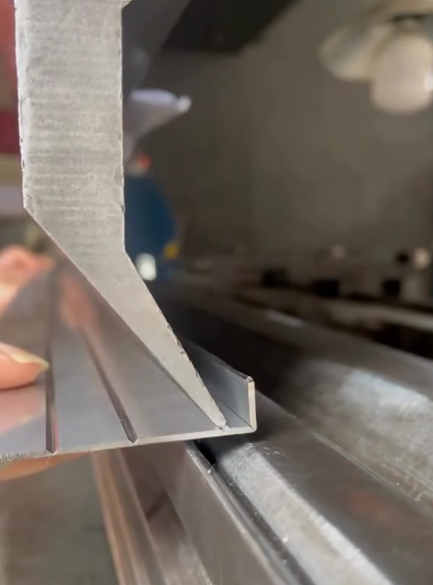
Why Does the Bend Line Become Stepped or Twisted with Segmented Tooling?
Segmented tooling is convenient, but every joint is a potential error point.
In vertical bending, gravity and vertical tonnage help seat the segmented tools firmly. But in box bending, where side force is involved, the force may try to shear the segments apart.
If each joint has only 0.001 inch of seating error, three joints can cause the punch tip to shift by about 0.005 inch. Segmented tooling also has a tonnage limit, often around 30 tons per foot. If overloaded, different segments may deflect differently, creating a stepped or twisted bend line.
Solution: segmented tooling should be precision ground, and interchangeable segment joint accuracy should be controlled within about 0.04 mm. For high-tonnage, short-stroke box bending applications, a one-piece solid tool is often better, because it distributes side force across the whole base instead of relying on “Lego-style” segmented assembly.
Square Tube Bending Collapse, Wrinkling, and Springback
If a square tube is placed directly into a V die, the outside wall is stretched and the inside wall is compressed. Without proper support, the tube wall may collapse inward, the bend area may wrinkle, and the part may spring back after release.
This is not a material problem. It means the die was not designed according to the tube section.
Solution: use a dedicated square tube forming die. The die groove should be made according to the square tube outside size and wall thickness, with a suitable radius at the groove bottom. If necessary, internal support or segmented pads can be used to hold the tube wall during forming. The bend radius and springback allowance should be adjusted based on actual material testing.
Square tubes, rectangular tubes, C-channels, and other closed or semi-closed sections should use dedicated forming dies instead of relying on standard V dies.
Tooling Selection and Use Guide
- If the workpiece has negative angles, undercuts, or closed structures, first ask whether side-push forming is needed. The limit of vertical tooling is determined by force direction. Changing the forming direction is often more effective than adding tonnage.
- Calculate clearance using “opening height minus full tooling height,” not bare machine opening height. After tooling and clamping systems are installed, usable clearance can be much smaller than expected.
- For horizontal bending, estimate the required tonnage as 1.2 to 1.3 times the vertical bending requirement. Horizontal tooling frames absorb energy through deflection. If the machine capacity is not enough, upgrade capacity first before discussing accuracy.
- For tooling profile selection, use straight tooling first for horizontal forming. Leave only the minimum necessary relief. Do not use deep gooseneck tooling for thick plate. Deep-relief gooseneck punches may be limited to around 25 tons per foot, while straight punches can often handle around 100 tons per foot depending on design.
- After a batch of horizontal forming work, check guide rail heating, scratches, and abnormal wear. If the machine alarms, stop and inspect. Excessive side load can permanently affect the machine’s normal bending accuracy.
- For complex parts, use a custom process: drawing review, tooling proposal, sample testing, and final delivery. One-step forming can reduce multiple bending steps and positioning errors.
Contact Shengpu Tooling
If you are looking for custom press brake tooling to solve box bending, deep cavity interference, square tube forming, or complex sheet metal bending problems, contact Shengpu Tooling.
Material and Process Parameters
Material: 42CrMo forged steel, Cr12MoV, and other tool steels selected according to working conditions.
Heat treatment: through hardening, commonly HRC 47±2; optional vacuum hardening and laser hardening.
Machining accuracy: precision grinding; parallelism can reach ±0.02 mm, and interchangeable segment joint accuracy can be controlled within ±0.04 mm.
Custom manufacturing: gooseneck punch throat depth, radius, angle, and working length can be customized according to the workpiece. Square tube dies can be grooved according to the tube section. Special forming dies and segmented tooling combinations can also be produced according to drawings.
Please send your material, thickness, bending angle, box dimensions, machine model, and product drawing. We can help evaluate a suitable special press brake tooling solution.
WhatsApp Business: +86 15155556086
Email: leah@sinobend.com
Website: shengputooling.com
No responses yet