What Is a Gooseneck Punch?
A gooseneck punch is a press brake punch with a relief cut into the body just above the tip. When a part already has formed flanges, the relief gives those flanges room to pass the punch during the next bend, so they do not hit the tool. It is also called a relief punch or clearance punch.
Shengpu Tooling makes gooseneck punches for stainless steel H channels, trim profiles and other parts with short return flanges. Every punch is made to the clamping system of your press brake.
Why a Standard Punch Cannot Bend These Profiles
On a profile with several bends, the flanges formed in earlier steps stand up next to the punch. With a straight punch, those flanges run into the punch body halfway through the next bend. The only ways around it are to change the bend sequence, redesign the part or split the profile into pieces.
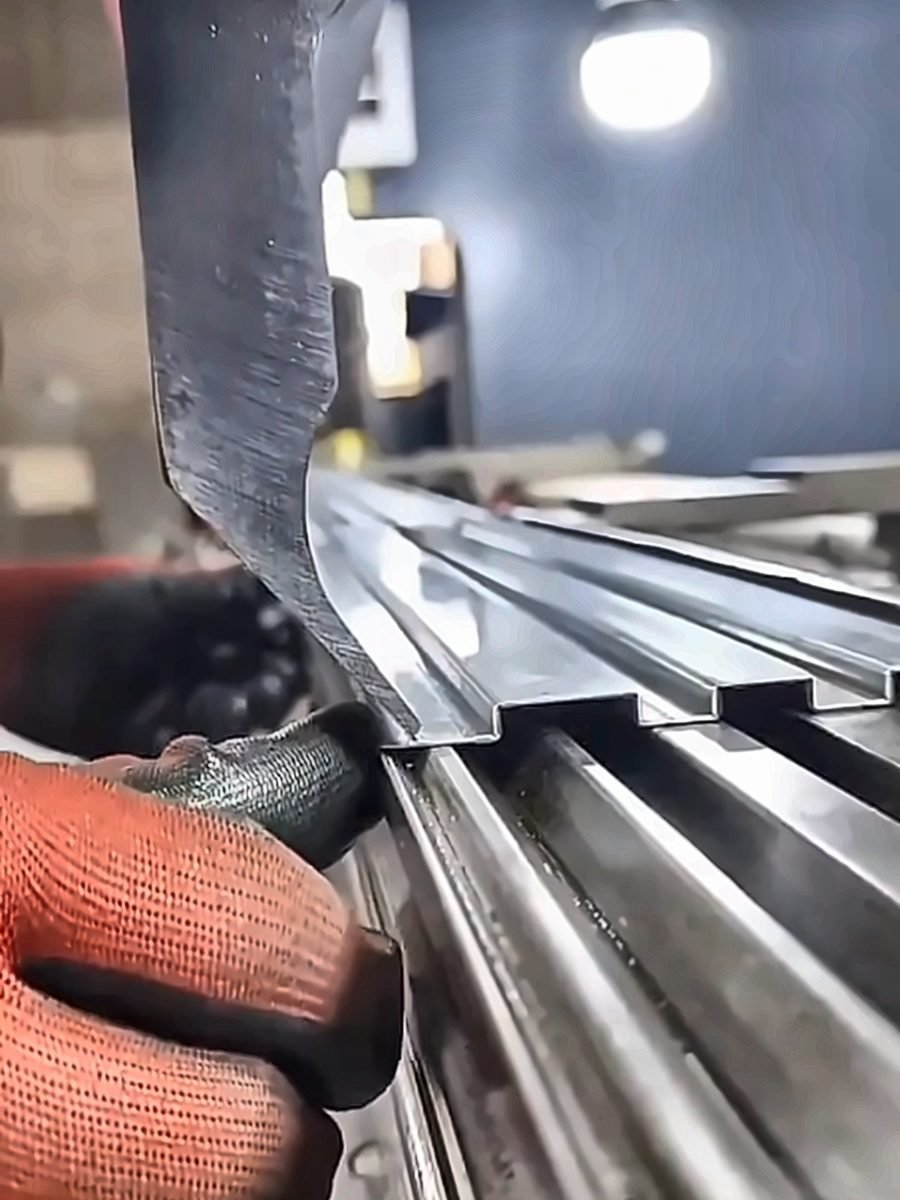
A gooseneck punch keeps the tip on the bend line but moves the punch body out of the way. The relief above the tip leaves space for the formed flange, so the next bend can be completed without collision.
What Problems Does It Solve?
| Shop-floor problem | Cause | Our solution |
|---|---|---|
| Short return flanges hit the punch and scratch the surface | The formed flange stands up against a straight punch body with no room to clear | A curved relief above the tip lets the flange slip into the clearance |
| No room for the punch on trim profiles and H-channel flanges | Shallow channels and narrow flanges leave no room for a wide punch body | A narrow 14 mm body reaches into shallow channels and tight cavities |
| Gooseneck punches chatter or lose angle on thicker sheet | A large throat turns the punch body into a lever arm and sharply lowers its tonnage limit | Only the minimum relief is cut, so the body stays nearly straight and is much stiffer than a large-throat gooseneck |
| An oversized relief wastes tonnage | The relief does not match the real flange height, so extra steel is cut away | The relief is sized to your measured flange height, no more than needed |
| Steps at segment joints, long bends not straight | Inconsistent grinding at segment joints lets errors add up | Segments are precision-ground as a matched set and interchangeable, with joint error ≤ 0.04 mm |
Specifications
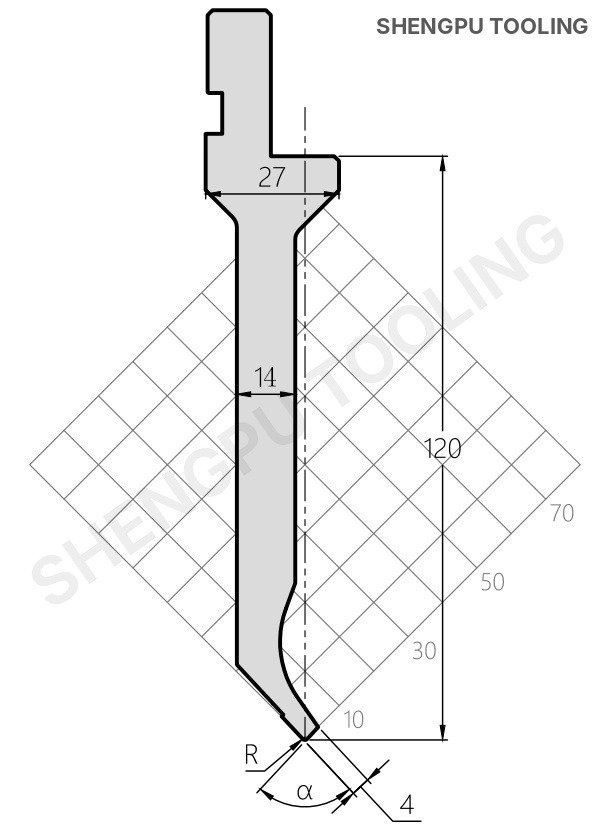
| Tool height | 120 mm (shoulder to tip) |
| Shoulder width | 27 mm |
| Body width | 14 mm (thinner bodies made to order for narrower channels) |
| Relief | Curved relief above the tip, sized to your flange height |
| Tip angle (α) | 85° |
| Tip radius (R) | 0.6 mm or 0.8 mm |
| Tool steel | 42CrMo (similar to AISI 4140) or Cr12MoV |
| Hardness | Through-hardened to HRC 48–52; laser hardening of the tip available |
| Precision | Precision ground; centerline, parallelism and perpendicularity within ±0.02 mm |
| Segment lengths | 500 / 800 / 835 / 1000 mm; ground as a matched set, joint error ≤ 0.04 mm |
| Weight | 835 mm segment: 13 kg; 800 mm segment: 12.2 kg |
| Clamping system | Made to the clamping system and tang of your press brake |
The dimensions above are from our standard drawing. Other heights, angles and relief shapes can be made to your drawing.
Application: Stainless Steel H Channels and Trim Profiles
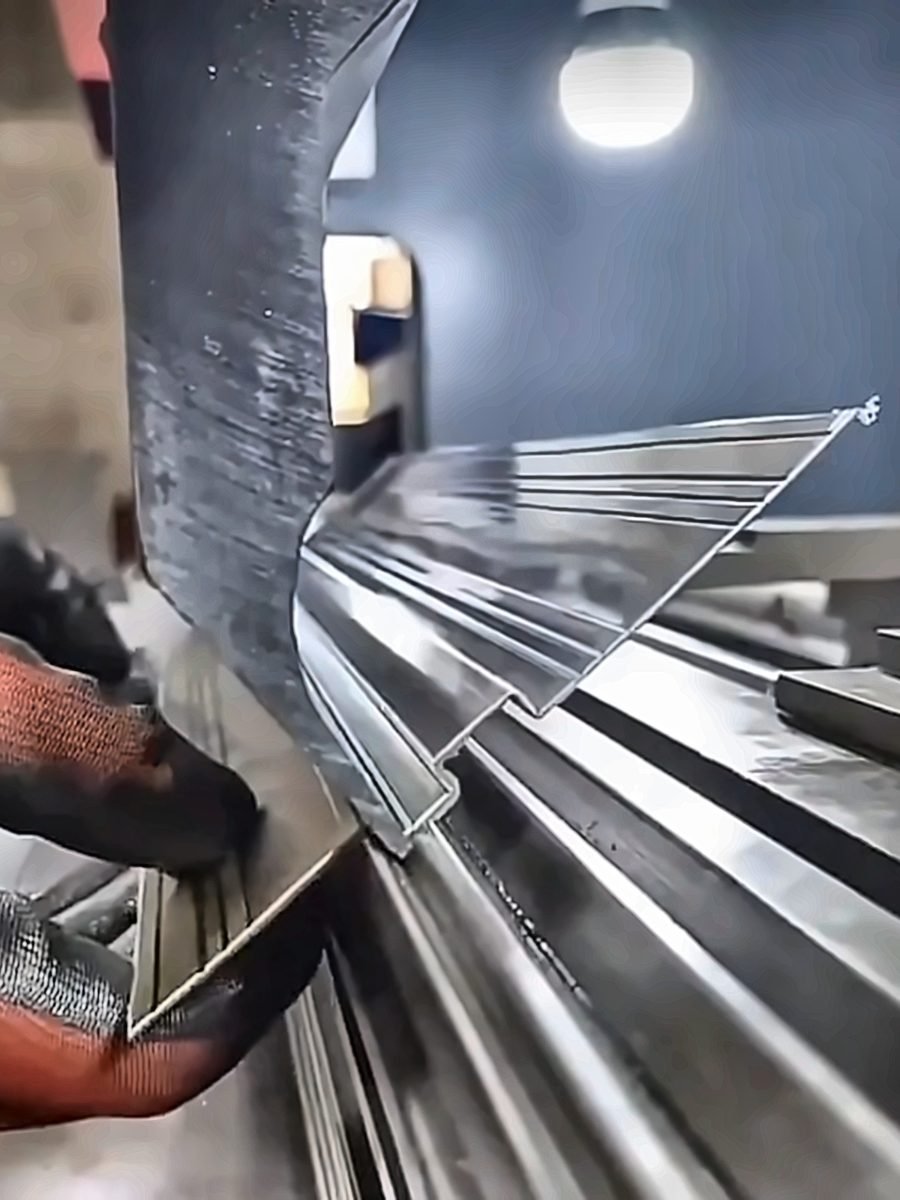
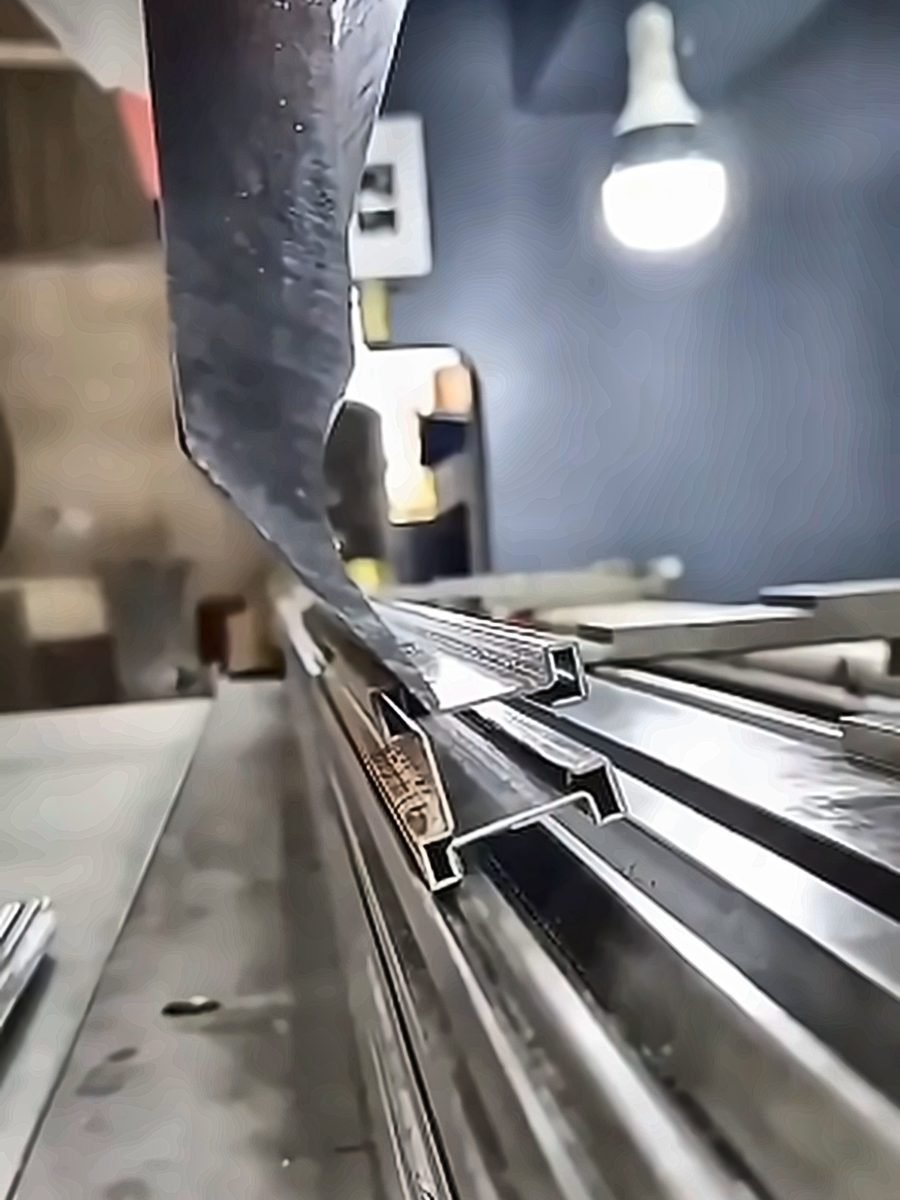
Stainless steel H channels and trim profiles are used for glass channels and decorative trim. They have several short return flanges within a small width, which makes them hard to bend with a straight punch. The photos below show our gooseneck punch bending these profiles one bend after another without collision. Click a photo to enlarge.

Made to Your Machine and Your Part
Every gooseneck punch is made to the tang and clamping dimensions of your press brake, so it fits your existing holders. If your part needs more clearance than this punch gives, for example a deep U channel or a deep box, send us the part drawing and we will design a punch for that profile. See also our special-shaped press brake dies and box bending tooling.
What to Send for a Quote
Send us any one of the following:
- A drawing of the punch you need
- Photos of your current punch, with the tang and clamping area visible
- A photo or drawing of the part you need to bend
It also helps to tell us the material, sheet thickness and your press brake model. If you don’t have an accurate drawing, send us a sample and we will measure it.
How an order goes:
- We send you a preliminary drawing to confirm before you pay a deposit.
- After the deposit, we send the production drawing for a second confirmation.
- Production starts only after you approve the production drawing.
FAQ
Will a 14 mm punch fit into my trim profile or H channel?
Yes. The narrow, straight 14 mm body is designed for shallow, narrow channels where a wide punch cannot reach. Before ordering, check that your channel is wider than the punch body. For narrower channels, we can make a thinner body to your measured profile.
Is a small relief above the tip enough? When do I need a large-throat gooseneck?
For short return flanges and shallow flanges, the formed flange only passes a short distance above the tip, so it fits into the curved relief. A large-throat gooseneck is only needed for tall box walls or deep flanges. We size the relief to your actual flange height, so no steel is removed without a reason.
Will it chatter or break on thicker sheet?
No, it won’t. The blade is essentially straight, ensuring the line of force remains unshifted. Since the relief cut only removes a small section of steel above the tip, the tool retains a load-bearing capacity comparable to that of a straight blade; it offers greater stability and is less prone to breakage than a gooseneck (swan-neck) tool when handling thick plates or operating under high-tonnage conditions.
How is the relief sized? Can you make it for my part?
Yes, every relief is made to your part. Send us the part cross-section, flange height and channel size, and we will set the position and depth of the relief from them: enough to clear the flange while keeping as much stiffness as possible. No drawing? Send us a sample and we will measure it.
How do you ensure material, hardness and accuracy? Will segment joints leave steps?
We use tool steels such as 42CrMo and Cr12MoV, through-hardened to HRC 48–52, with optional laser hardening of the tip. Punches are precision ground, with centerline, parallelism and perpendicularity within ±0.02 mm. Standard segment lengths are 500, 800, 835 and 1000 mm. Segments are ground as a matched set and are interchangeable, with a joint error of 0.04 mm or less. The tang is made to the clamping system of your press brake.
Get a Quote
Got a profile your tooling can’t bend? Send us your drawing and we will make a punch for it. Contact us, WhatsApp +86 15155556086 or email leah@sinobend.com.