How to Use a 2V Die Correctly for Stable Press Brake Bending
How to Use a 2V Die Correctly for Stable Press Brake Bending
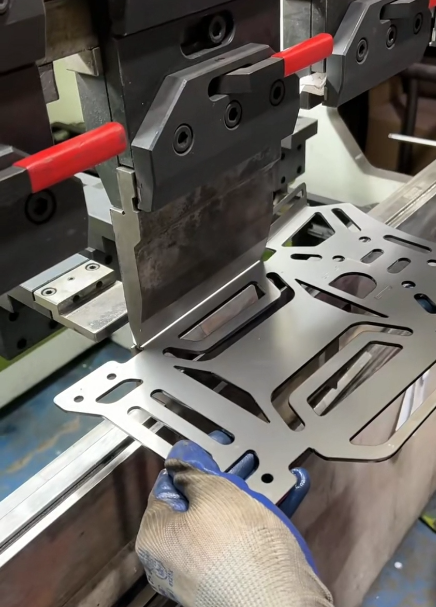
Can a row of standard straight punches and one double V die solve most common bending jobs? Yes, in many sheet metal workshops, this is one of the most practical press brake tooling combinations.
But if the tooling is not selected or aligned correctly, the same setup can still create scrap parts, surface marks, unstable angles, damaged tooling, and poor bending consistency.
A standard straight punch and double V die are simple, but they are not “error-proof.” Problems often come from wrong V die opening selection, poor centering after flipping the die, mismatch between punch tip radius and material thickness, or using this tooling combination for parts that actually require special tooling.
This article explains the real pain points and correct use of standard straight punch + 2V die.
What Are Standard Straight Punch and Double V Die?
1. Standard Straight Punch
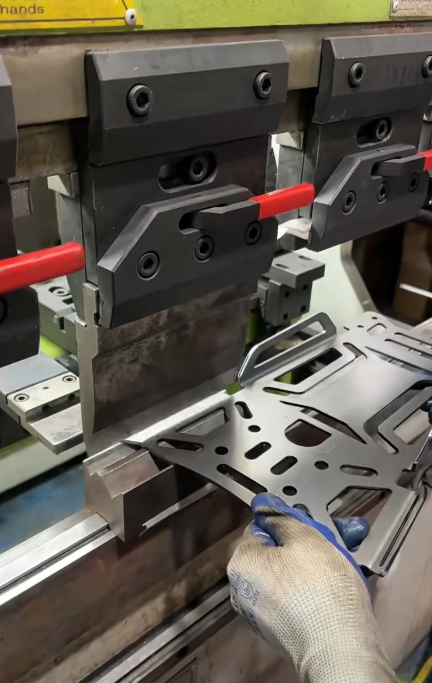
A standard straight punch is one of the most common upper tools used in press brake bending. It works like the “rigidity reference” of press brake tooling.
The punch body is relatively straight, the load centerline is aligned with the ram movement, and there is less bending moment under vertical loading. Because of this, a straight punch usually has strong load capacity. In many standard applications, straight punches can handle high tonnage compared with deep gooseneck tools.
It is commonly used for:
90-degree bending.
Air bending.
Open sheet metal parts.
Simple L-shaped parts.
Straight-line bending.
Only when the workpiece needs extra clearance, such as box bending or return flanges, should operators consider gooseneck punches or other special tooling.
2. Double V Die / 2V Die
A double V die, also called a 2V die, has two different V openings on one lower die. Common combinations include V8 + V12, V16 + V24, or different angle grooves depending on production needs.
By flipping the die, the operator can switch between two V die openings without replacing the whole lower die.
This is very useful for workshops that process nearby material thicknesses or small batches with different bending requirements. One die can do the work of two dies, reducing tooling cost and saving setup time.
3. Why This Combination Is Popular
The standard straight punch provides stable vertical force.
The double V die provides fast V opening change.
For example, when switching from a 2 mm job to a 1.5 mm job, the straight punch may stay on the machine, while the 2V die is flipped to another V opening. The changeover can be completed quickly, and tooling inventory can be reduced.
The advantages are clear:
One lower die covers more sheet thicknesses.
Changing V openings is faster than changing the whole die set.
Suitable for daily sheet metal bending.
Reduces tooling inventory.
Works well for small-batch and multi-size production.
Wrong V Die Opening: The 8 times Rule and Shop Floor Reality
Many operators choose a smaller V opening when they need to bend a short flange. This can help support the short flange, but the cost is higher bending force.
The smaller the V die opening, the more concentrated the contact pressure becomes near the bending line. For stainless steel, aluminum, galvanized sheet, and visible surface parts, this can create more obvious press marks.
If the operator continues to increase pressure, several problems may appear:
Deeper marks along the bending line.
Surface scratches.
Over-bending.
Wear on the die shoulders.
Machine tonnage close to the limit.
Local deformation on thin sheet metal.
The V die opening affects bending force, inside radius, and minimum flange length at the same time.
A common starting rule is the 8T rule:
V opening ≈ 8 × material thickness
For example, a 2 mm sheet is often matched with about V16 as a starting reference.
But this is not a fixed rule for every material. It should be adjusted according to material type:
Thin sheet: about 6T-8T.
Stainless steel and high-strength steel: about 10T-12T.
Aluminum: about 5T-6T in many common cases.
So the question is not only “Can this V opening hold the short flange?” You also need to consider surface quality, inside radius, required tonnage, and tooling life.
Flipping Misalignment: The Hidden Accuracy Problem of Double V Die
The flexibility of a double V die also has a cost.
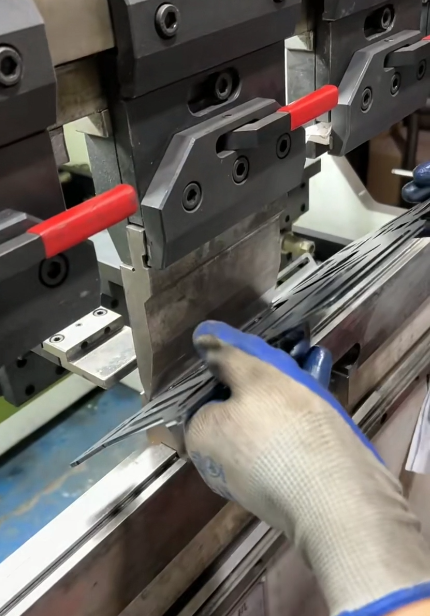
After flipping the die, the surface that was previously used as a load surface may become a reference surface. If chips, dust, burrs, or small deformation remain on the die seat, the flipped die may not sit correctly.
This can cause the punch tip to move away from the centerline of the V groove.
Once the punch and V groove are not centered, the bending force becomes unbalanced. The angle may become inconsistent along the full bending length. This problem is often misjudged as “machine parameter drift,” and the operator may keep adjusting the machine, making the problem even worse.
Solutions:
Clean the load surface and die seat before flipping the 2V die.
After switching the V opening, make one dry run and visually check whether the punch tip is centered with the V groove.
If the angle is inconsistent along the full length, check tooling alignment before changing machine parameters.
If the die seat is worn beyond tolerance, replace it instead of using shims to hide the problem.
Standard Straight Punch Selection and Maintenance
Although a standard straight punch is highly versatile, it still has several common risks.
The first risk is punch angle mismatch. For example, using an 88-degree punch to bend a 90-degree part is common when springback compensation is needed. But for hemming, acute angle bending, or special forming, a different punch angle may be required.
The second risk is mismatch between punch length and V die opening. If the setup is not suitable, edge marks or local pressure problems may appear.
The third risk is continuing to use a chipped or burred punch tip. Once the punch edge is damaged, the same defect can be printed onto every workpiece.
A good practice is:
For main 90-degree bending, choose an 88-90 degree straight punch according to material and springback.
For special angles, use a dedicated punch profile.
If the punch edge is chipped or has burrs, grind or replace it quickly.
For long workpieces, align segmented punches carefully to avoid overload on one section.
How to Select Standard Straight Punch + Double V Die Correctly
A safer selection process is:
Check material thickness first.
Check minimum flange length.
Confirm the required inside radius.
Confirm whether surface marks are acceptable.
Check whether the required tonnage is within the machine and tooling capacity.
Confirm the punch tip radius.
Confirm both V openings on the double V die.
Check whether the workpiece has any interference risk.
Record angle compensation after trial bending.
For mild steel, many workshops use 6T-8T as a starting V opening reference.
For stainless steel, aluminum, high-strength steel, or visible parts, the V die opening should be adjusted according to material condition, surface requirements, and trial bending results.
When Should You Use a Double V Die?
A double V die is suitable for:
Common straight-line sheet metal bending.
Multiple material thicknesses.
Small-batch production.
Workshops that do not want to change lower dies frequently.
Machines that need to cover several common V openings.
Open workpiece structures.
Parts without deep box interference or complex clearance requirements.
However, if the part has strict appearance requirements, tight angle tolerance, very short flange length, or high-strength material, the V die opening and punch tip radius must be checked more carefully.
Contact Shengpu Tooling
If you are using a standard straight punch + double V die but still face unstable angles, short flange support problems, surface marks, high tonnage, or workpiece interference, you can send your drawing and bending parameters to Shengpu Tooling.
Please provide material, sheet thickness, bending angle, inside radius, minimum flange length, machine model, and current V die opening size.
We can help evaluate whether you need to adjust the 2V die selection or customize a more suitable press brake tooling solution.
WhatsApp Business: +86 15155556086
Email: leah@sinobend.com
Website: shengputooling.com
No responses yet