Many customers face the same problem in sheet metal bending: the drawing requires a smooth large radius, but the finished part comes out with cracks, obvious press marks, unstable angles, or an uneven curved shape.
Sometimes the operator adjusts the machine many times, but the result still does not improve. In this situation, the problem may not be the press brake machine. Very often, the real reason is that standard press brake punches and press brake dies are not suitable for large radius forming.
When a part requires a smooth curved bend instead of a sharp angle, a radius punch and radius die are usually the better tooling solution.
Why Standard Press Brake Tooling May Not Work
Standard press brake punches and dies are mainly used for common V bending. They are suitable for many sheet metal parts, but when the workpiece requires a large radius bend, the contact area, forming space, and bending force become different.
If the punch radius is too small, the material may be stretched too much during bending. This can cause surface cracks, heavy bending marks, or deformation near the bend line.
If the lower die opening or die profile is not matched correctly, the sheet metal may not flow smoothly during forming. This can lead to unstable bending angles, poor repeatability, and inconsistent radius size.
For customers using a sheet metal press brake, electric sheet metal brake, mini press brake, or bending brake machine, the tooling must match the actual bending requirement. The machine provides force, but the tooling decides the final forming result.
What Are Radius Punch and Radius Die?
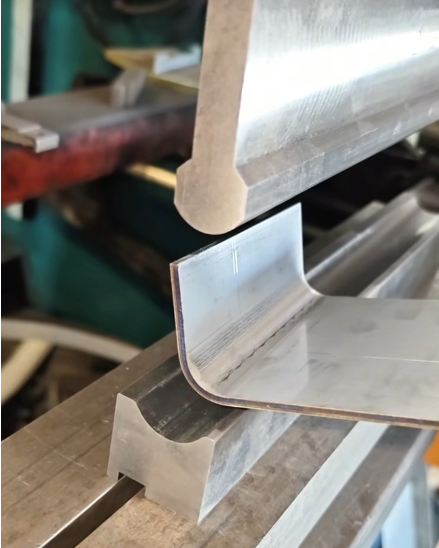
A radius punch is an upper press brake punch with a larger nose radius. It is designed to form smoother bends and reduce sharp stress concentration on the sheet metal.
A radius die is the matching lower die used to support the material during radius bending. Together, the radius punch and radius die help the sheet metal form a controlled curved shape instead of a sharp bend.
This tooling combination is commonly used for parts such as covers, panels, enclosures, decorative metal parts, cabinets, large curved components, and non-standard sheet metal products.
When Should You Choose Radius Punch and Radius Die?
You may need radius punch and radius die tooling when your product has one of these problems:
The bend area cracks after forming.
The workpiece has obvious press marks.
The required bend is a large smooth radius.
The final radius is not consistent.
The angle changes after repeated adjustment.
The standard V die cannot support the material correctly.
The customer drawing requires a specific inside radius.
If these issues happen repeatedly, continuing to adjust the machine may waste more time and material. Choosing the right press brake tooling is usually the more effective solution.
How Radius Tooling Helps Improve Bending Quality
A properly designed radius punch and radius die can help distribute bending force more evenly. This reduces stress concentration and helps protect the surface of the workpiece.
For sheet metal press brake bending, this is especially important when working with stainless steel, aluminum, galvanized sheet, or parts with high surface requirements.
The right radius tooling can help customers achieve:
Smoother curved bends.
Fewer cracks on the bending area.
Reduced surface marks.
More stable bending angles.
Better repeatability in batch production.
Lower rework and scrap rate.
For manufacturers comparing press brake for sale options or upgrading their bending process, tooling selection should not be ignored. Even a good press brake machine cannot produce stable results if the punch and die are not suitable.
Shengpu Tooling’s Custom Solution
Shengpu Tooling manufactures custom press brake punches, press brake dies, radius punch and radius die tooling for different sheet metal bending applications.
Before production, we can review your product drawing, material thickness, bending angle, required inside radius, workpiece length, and machine clamping system. Based on this information, we help design a suitable tooling solution for your bending requirement.
Whether you are using a standard sheet metal press brake, electric sheet metal brake, mini press brake, or bending brake machine, Shengpu Tooling can customize tooling according to your machine and product needs.
Contact Shengpu Tooling
If your large radius bends are cracking, leaving marks, or failing to match the drawing, send us your product drawing or sample photo.
Shengpu Tooling can help evaluate whether you need a radius punch and radius die, or another custom press brake tooling solution.
WhatsApp Business: +86 15155556086
Email: leah@sinobend.com
Website: shengputooling.com
No responses yet