A Better Hemming Die Solution for Cracking, Springback, and Sharp Edges
A Better Hemming Die Solution for Cracking, Springback, and Sharp Edges
Is There a Thin Crack on the Outer Edge of the Hemmed Bend?
Cracking, springback, bulging — when these problems appear during hemming, many people first think, “The material is not good enough,” or “The pressure is not enough.” So they increase the tonnage.
But the result is often worse: more cracks appear, the die chips, and even hydraulic cylinders may be damaged.
The real problem is usually not the tonnage. It is the die geometry and the bending sequence.
More Pressure, More Cracks: Causes and Solutions
1. Symptoms and Mechanism
Cracks usually appear on the outer edge of the hemmed bend, forming thin lines along the bending line.
The mechanism is not complicated. During bending, the outer fibers are stretched and the inner fibers are compressed. Hemming requires the material to complete a 180-degree fold, which pushes the outer layer close to its elongation limit.
If the pre-bending radius is too small, the material’s ductility may already be exhausted before the final flattening stage. The hemming process then simply enlarges the micro-cracks created during pre-bending into visible cracks.
2. Root Causes
Pre-bending radius is too small, less than 1T
The neutral axis moves inward significantly, and the outer fibers are stretched too much.
V opening is too narrow
The material is not being bent properly; it is being squeezed until it cracks. During flattening, the tonnage curve may show a sudden peak.
Bending along the rolling direction
The material may tear along the grain boundary, especially with thicker sheets.
Material elongation is too low
When elongation is lower than 15%, flat hemming is very likely to cause cracking.
Sheet thickness over 2 mm, or 14 gauge, is forced into flat hemming
The material’s elastic capacity is exhausted, and both the inner and outer layers may fail.
3. Solutions
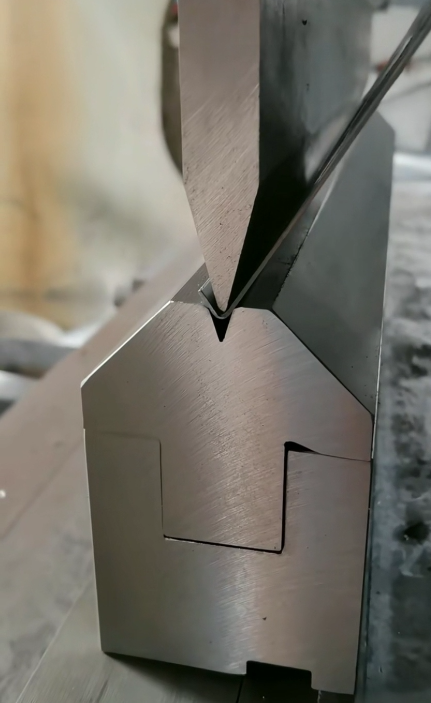
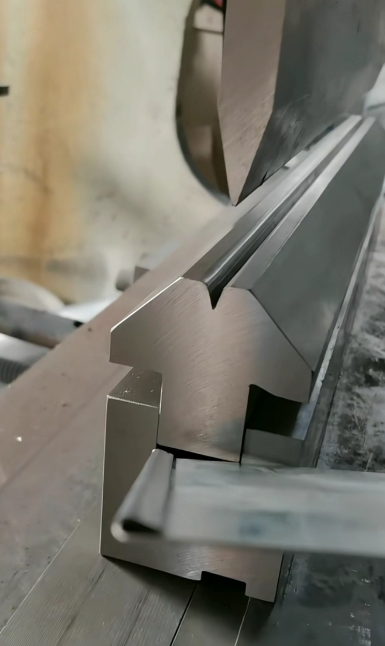
Use a teardrop hemming die
Leave a gap at the top of the hemmed bend and keep an inside radius of about 1/3T to 1/2T. This spreads the strain over a larger area and helps protect the grain structure. For thicker sheets and harder materials, this is often the safer default solution.
Increase the pre-bending radius to 1.5T to 2T
A larger pre-bending radius distributes the initial stretching more evenly and leaves more ductility for the final hemming stage.
Adjust the V opening according to the material
For mild steel, 6T can be used as a reference. For hard aluminum, 8T to 10T is often more suitable. The narrower the V opening, the higher the required tonnage rises, and the more easily the material may be squeezed and cracked.
Keep critical hemming bends perpendicular to the rolling direction when possible
If bending along the rolling direction is unavoidable, increase the pre-bending radius by another 20% and use a teardrop-shaped section.
If elongation is lower than 15%, avoid flat hemming
Use a teardrop-shaped hemming solution by default. Do not gamble on the material.
Springback After Hemming
After the hem is pressed closed, it springs open as soon as the pressure is released, like a shell opening. This is the elastic memory of the material. Once the load is removed, the elastic deformation tries to recover.
Forcing more pressure only spends energy on elastic deformation. If the die geometry is wrong, the material cannot enter the plastic deformation zone, and the shape cannot be locked.
This is a typical “tonnage trap”: adding force does not reduce springback. It only increases brittleness.
The solution can be divided into three steps:
Overbend by 2 to 3 degrees during pre-bending
This allows the final hemming stage to focus on vertical compression and helps offset springback.
Use geometry to lock the shape
A teardrop-shaped hemming compound die keeps an inside radius and holds the material in the plastic deformation zone more reliably than force alone.
Distinguish springback from under-pressing
If the hem closes under pressure but opens after release, it is springback. If it never closes from the beginning, it is under-pressing, often caused by an overly wide pre-bending angle. These two problems require different solutions.
Sharp Edges Affect Safety and Assembly
Many sheet metal parts may have sharp edges or burrs if they are only cut or formed with ordinary bending tools. For electrical cabinets, machine enclosures, appliance panels, and mechanical housings, this affects not only appearance but also assembly safety.
A proper hemming die can wrap the sheet metal edge and hide the sharp edge, making the part smoother and safer to handle.
A teardrop-shaped hem can also increase edge thickness and stiffness, giving the final product a more complete and reliable appearance.
Shengpu Tooling Customizes Press Brake Dies According to Your Machine
Every press brake has different brand specifications, tonnage, stroke height, installation interface, and V-die requirements.
A universal die installed on an unmatched machine may cause unstable positioning, uneven pressure, difficult tool changes, or even machine damage.
Shengpu Tooling’s core principle is to provide custom press brake tooling based on the customer’s machine. We design the bending machine die according to your equipment parameters, so the tooling matches the machine instead of forcing the machine to adapt to the tooling.
With proper matching, the die can be clamped correctly, the hemming force can be controlled more accurately, and both efficiency and consistency can be improved.
As a custom sheet metal bending mold manufacturer, Shengpu Tooling can design hemming die, compound hemming die, teardrop hemming die, and other custom press brake tooling solutions according to your material, thickness, bending angle, hemming structure, and press brake model.
Contact Shengpu Tooling
Contact us and we will send you a detailed tooling shape selection guide!
If you are facing cracking, springback, bulging, sharp edges, or unstable hemming results, send us your drawing, material thickness, bending angle, hemming form, and machine information.
Shengpu Tooling can help evaluate whether a Teardrop-shaped hemming compound die or another custom press brake tooling solution is more suitable for your production.
WhatsApp Business: +86 15155556086
Email: leah@sinobend.com
Website: shengputooling.com
No responses yet