Custom Press Brake Tooling for Negative Angles, Box Parts, and Closed Bending
Side-Push Bending Die
Custom Press Brake Tooling for Negative Angles, Box Parts, and Closed Bending
No Space for the Upper Punch to Move Down? The Problem May Be the Direction of Force
In many sheet metal bending projects, the problem is not that the press brake lacks tonnage. The real problem is that the forming direction is wrong.
A press brake ram moves vertically. The crowning system also compensates vertical deflection. But when the work piece requires side forming, such as negative angles, undercuts, closed profiles, deep box flanges, or internal bends, standard vertical tooling reaches its physical limit.
The upper punch may have no space to move down. The already-formed edge may interfere with the punch, die, machine frame, or clamping system. In this situation, adding more tonnage does not solve the problem.
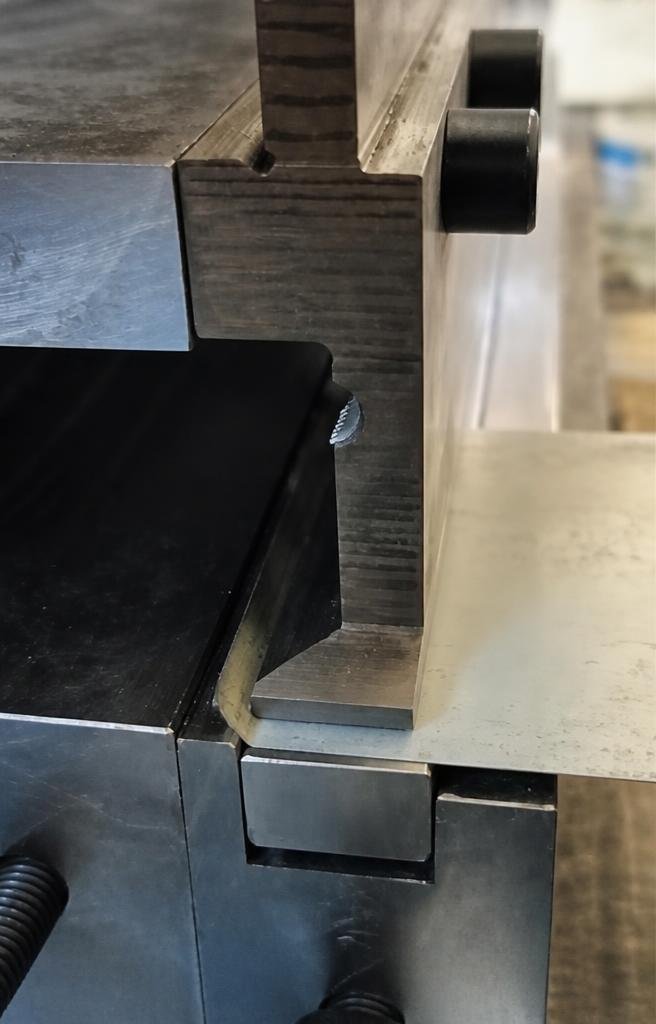
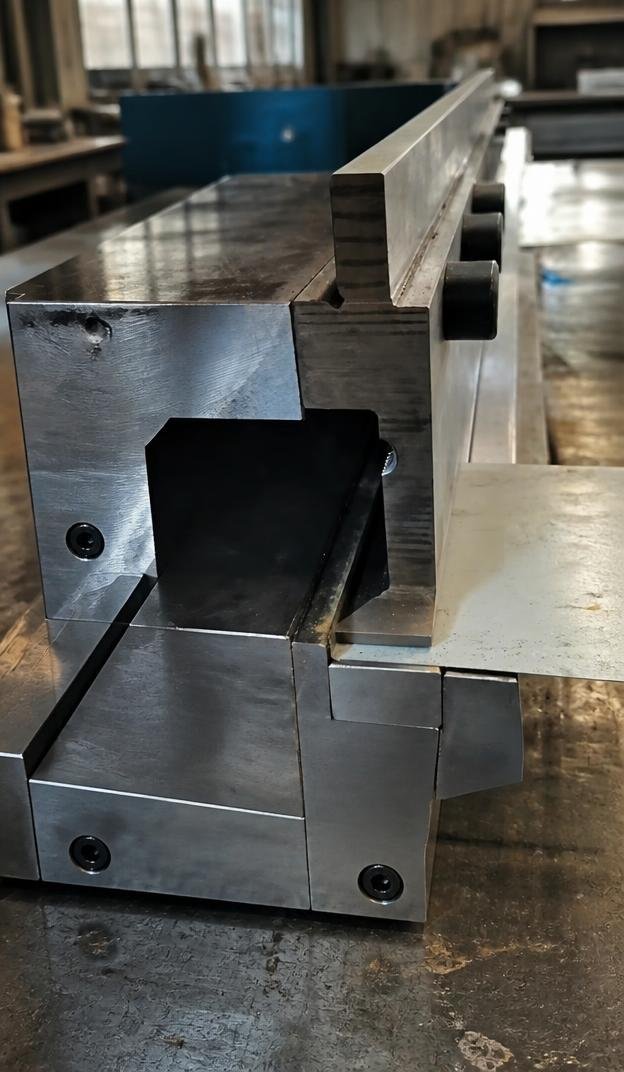
The solution is a tooling structure that converts vertical force into horizontal force: a side-push bending die, also called a side-action bending die, horizontal bending tooling, or a custom bending die for special press brake forming.
What Is a Side-Push Bending Die?
1. Principle: Cam and Wedge Mechanism Converts Vertical Force into Horizontal Force
The core structure of a side-push bending die is usually a cam or wedge mechanism.
When the upper tool moves downward, the wedge surface pushes a side slider horizontally. This converts the vertical ram movement into a 90-degree horizontal forming force.
The press brake itself does not need modification. By changing the tooling, the machine gains the ability to perform a horizontal bending action. In this sense, the die works like a compact horizontal forming unit mounted on a standard press brake.
This makes it a useful sheet metal bending tool for parts that cannot be formed by ordinary vertical bending.
2. When Should You Consider a Side-Push Solution?
A side-push bending die may be needed when:
The work piece has a negative angle or undercut structure.
A closed box part interferes with the upper punch during the final bend.
The part needs one-step forming instead of several separate bending operations.
Standard tooling cannot provide the required punch shape, die clearance, or forming direction.
The product cannot be split and welded because strength, appearance, or accuracy must be maintained.
For these cases, the issue is not only bending angle. It is the forming path and available space.
3. Why Standard Press Brake Tooling Cannot Do It
Standard press brake tooling is suitable for open bending structures, such as L-bends, U-bends, 90-degree bends, and most straight-line bending jobs.
But when the work piece becomes closed, deep, or spatially limited, common problems appear:
The already-formed edge blocks the upper punch.
The side wall is too high for the punch to clear.
The bend is inside a box-shaped part.
The required forming direction is horizontal, not vertical.
The next bending step collides with the formed edge.
The part must be formed as one piece without welding.
In these cases, simply changing the V opening is not enough. The problem is not the V groove. The problem is interference and force direction.
The “Structure Cost” of Horizontal Bending: Tonnage Loss and Uneven Angles
1. Mechanism: Force Changes Direction, and the Cost Changes Too
Converting vertical force into horizontal force is not free.
The wedge, slider, guide surface, friction, and frame deformation all consume part of the machine energy. This is sometimes understood as the “structure cost” of horizontal forming.
A job that may require 30 tons in a normal vertical bending condition may need 40 tons or more in a horizontal unit. In many cases, the press brake capacity should be checked with a 20% to 30% safety allowance.
Another important issue is accuracy.
Under horizontal load, the tooling structure may open slightly at the front under full pressure. In some horizontal bending tools, this can cause a small “toe opening” effect. The result may be a tapered bend: the flange angle is tighter at the bottom and looser at the top.
The press brake crowning system corrects vertical deflection, but it cannot fully compensate for horizontal tooling deflection.
2. Practical Solutions
Choose a rigid punch profile first
For horizontal bending, straight tooling is usually preferred. If clearance is required, use a modified straight punch with only the minimum necessary relief. Avoid unnecessary deep gooseneck shapes when bending thick material.
Use one-piece tooling when possible
Modular tooling is convenient, but under horizontal shear force, module joints may move slightly. This can create a stepped bending line. A one-piece steel tooling base can distribute side force more evenly.
Use a fixed hard stop reference
The backgauge or positioning reference should be physically connected to the horizontal tooling body when needed. This helps reduce positioning drift caused by adapter movement.
Be careful with deep flanges
When the flange depth exceeds about 5 inches, the force path becomes more complex. Pins, sliders, bolts, and guide surfaces can all become sources of angle error. For deep flanges or high-accuracy parts, an integrated custom bending die design is usually safer.
Practical Action Checklist
- If the part has negative angles, undercuts, or closed structures, ask first whether a side-push bending die is needed.
- Calculate clearance using opening height minus the full tooling height, not only the bare machine opening.
- For horizontal bending, estimate the required tonnage as about 1.2 to 1.3 times the normal vertical bending requirement.
- For tooling selection, use straight tooling first. Keep relief areas as small as possible. Avoid deep gooseneck tooling for thick material unless necessary.
- After a batch of horizontal bending work, check guide surfaces, heat, scratches, and abnormal movement. If the machine alarms, stop and inspect.
- For complex parts, follow a custom process: drawing review, tooling proposal, sample testing, and final production tooling.
Shengpu Tooling Solution
Shengpu Tooling provides special press brake tooling for side forming, horizontal bending, negative angles, box parts, closed profiles, and complex sheet metal components.
We can evaluate your drawing, material, thickness, forming angle, bend position, machine model, and clamping system to determine whether a side-push bending die, side-action bending die, horizontal bending tooling, or another custom bending die is the right solution.
Our goal is not to make the tooling complicated. Our goal is to make difficult sheet metal parts easier, safer, and more stable to produce.
Contact Shengpu Tooling
If you are looking for special press brake tooling to solve side bending, horizontal forming, or interference problems in complex sheet metal parts, contact Shengpu Tooling.
Please send your material, thickness, bending angle, forming position, machine model, and product drawing. We can help evaluate whether you need a side-push bending die or a custom bending die solution.
WhatsApp Business: +86 15155556086
Email: leah@sinobend.com
Website: shengputooling.com
No responses yet