Not Sure Which Press Brake Punch to Choose?
Press Brake Punch Guide: How to Choose a Shortened Straight Punch
When you choose a press brake punch, height matters as much as tip angle and tip radius. A shortened straight back punch, also called a short straight punch, has a low working height and a solid body. It suits press brakes with limited open height and parts with shallow flanges. It cannot form deep boxes, though, and buying the wrong height usually means buying a second, taller set later.
This guide draws on The Fabricator, WILA, Wilson Tool and published tooling catalogs. It explains what a shortened straight punch solves, how it differs from other punches, how to check open height, and the most common selection mistakes.

What Is a Shortened Straight Punch?
A press brake punch is the upper tool mounted on the ram that presses the sheet into the die. The straight punch is the most basic type: a flat back, a centered tip, and use in standard right-angle bends. Its body is much thicker than its tip, so it handles high tonnage without deflecting. The trade-off is limited clearance, so formed flanges can hit the punch body (Durma).
A shortened straight punch is a straight punch in the lowest height class of its clamping system. Its tip angle and profile match a regular straight punch; only the height is different.
In the Amada-Promecam system, the most common one, standard straight punches come in working heights of 67, 90, 95, 100, 105 and 120 mm (Accurtool). The 67 mm class is what is usually called the shortened punch; 100–120 mm is regular height. Examples from published catalogs:
| Model (maker) | Angle / tip radius | Working height | Rated load |
|---|---|---|---|
| P.97.88.R08 (Rolleri) | 88° / R0.8 | 66.65 mm | 1000 kN/m |
| 1027 (Eurostamp) | 60° / R2 | 67 mm | 80 t/m (about 785 kN/m) |
| 1309 (Eurostamp) | 85° / R0.8 | 120 mm | 70 t/m (about 686 kN/m) |
Other clamping systems use different height classes. American precision straight punches, for example, are commonly in a 3.75-inch family with a working height of about 94–95 mm (American precision tooling catalog). “Shortened” is relative to the regular height of the same system, not a fixed size.
The calculations below use the 67 mm Amada-Promecam shortened punch as the example.
In short, a shortened straight punch is not a cut-down punch. It is a dedicated punch for machines with limited clearance and for simple bends.
Why Use a Short Press Brake Punch? Height vs. Flexibility
A shorter punch frees more open height and, within comparable models, often carries a higher load. It also forms shallower boxes. Whether it is the right choice depends on which is more limited: your machine or your parts.
Benefit 1: More open height
Open height is the distance from the bottom of the ram to the top of the bed when the press brake is fully open. Stroke is open height minus closed height. Tool holders and adapters all use up part of the open height (Wilson Tool).
WILA’s rule of thumb is to leave at least about 100 mm between the upper and lower tools; otherwise the sheet will not fit or the tools cannot be installed (WILA). On small or older press brakes, or machines fitted with tall dies or risers, replacing a punch of 100 mm or more with a 67 mm punch recovers about 30–50 mm of space.
Benefit 2: Often a higher load rating within comparable models
One Italian toolmaker’s published catalog lists these 88°, C45 straight punches:
| Model | Working height | Tip radius | Max load |
|---|---|---|---|
| P.97.88.R08 | 66.65 mm | R0.8 | 1000 kN/m |
| P.130.88.R08 | 100 mm | R0.8 | 400 kN/m |
| P.135.88.R08 | 104.65 mm | R0.8 | 500 kN/m |
Source: Rolleri.
These models do not share exactly the same profile, so height is not the only reason for the difference. The same catalog also lists a low punch rated at only 350 kN/m. Always check the rating of the specific model rather than judging by height.
Benefit 3: Lighter and easier to change
Taller punches are heavier. In the WILA system, top tools up to 12.5 kg can be loaded vertically, while heavier ones must slide in horizontally from the side (WILA). A low punch is easier for one operator to carry and install, which helps when tools change often.
The cost: less flexibility
This is the point to settle before you buy. The Fabricator advises: “Always invest in the tallest tooling combination that your machine’s open height will allow,” and warns that buying a tool that is too short is a common, costly mistake (The Fabricator). WILA also notes that a low working height often means buying a taller punch later.
Key point: a shortened straight punch does not replace a general-purpose punch. It is a dedicated size for specific machines and parts. If your open height is generous and your part mix is wide, start with a taller punch.

How to Check Open Height and Box Depth
Before choosing a shortened punch, check two things: how much space remains once all tooling is installed, and how tall a punch your deepest box needs.
Remaining space
Remaining space = open height − upper tool holder − die holder and die − punch working height
Keep at least about 100 mm of remaining space (WILA), and more than your tallest flange needs. Do not judge by the bare machine’s open height; always calculate with the full tooling installed.
The values below are an example only. Assume a press brake with 370 mm open height, a 70 mm upper tool holder, and 100 mm for the die holder and die:
| Punch working height | Remaining space between tools | Meets the ~100 mm guideline? |
|---|---|---|
| 120 mm | 80 mm | No |
| 100 mm | 100 mm | Just meets it |
| 67 mm | 133 mm | Yes |
In this example the 120 mm punch leaves too little space, the 100 mm punch leaves no margin, and the shortened punch gives the most room for loading and unloading parts. Also confirm that the stroke lets the punch reach the required depth.
Box depth
The Fabricator gives a rule of thumb for four-sided boxes: the punch height (or punch plus extender) should be about 1.7 times the box depth (The Fabricator). Working backward gives the approximate box depth each punch height can form:
| Punch working height | Four-sided box depth (estimate) |
|---|---|
| 67 mm (shortened) | about 39 mm |
| 100 mm | about 59 mm |
| 120 mm | about 71 mm |
Three-sided boxes need less height, because one formed side can hang outside the machine during the last bend (The Fabricator). For L, Z or shallow U parts, a shortened punch is fully adequate.
How to Choose a Shortened Straight Punch: 6 Steps
- Calculate clearance first, then choose the height. Use the method above to check remaining space and box depth. If a regular punch will not fit, or your parts all have shallow flanges, choose the shortened punch.
- Choose the tip angle. Use 88° or 90° for standard right angles (88° allows for springback); 85° suits stainless and high-strength steel with more springback. Shortened straight punches also come in 60°, such as a 67 mm, R2, 60° punch (Eurostamp), for bends between 60° and 90°. For angles below 60° and hem pre-bends, use an acute punch (Durma).
- Choose the tip radius. Use a small radius (R0.6–R1) for thin sheet and visible parts, R1.0 or larger for aluminum and coated sheet to reduce marking, and a larger radius for thick or hard material to avoid outer-surface cracking. In air bending, the die’s V-opening mainly sets the inside radius; a tip that is too sharp only creases the sheet and makes angles less consistent.
- Check load and tonnage. Shortened straight punches are short and rigid, but ratings vary widely by model. In published catalogs, European short punches around 67 mm range from about 350 kN/m to 1000 kN/m (Rolleri). American 3.75-inch (about 95 mm) straight punches are rated 30–50 tons per foot (about 89–149 t/m) depending on tip radius, with larger radii rated higher (American precision tooling catalog). Calculate bending force from actual thickness, V-opening and bend length, and use the lowest rating among punch, die and machine.
- Confirm the clamping system. Common systems include American, Promecam, European, WILA and Amada. The press brake punch and die must belong to the same clamping system to keep the centerline aligned. Confirm the final choice against the machine brand, model, clamping method and tool height.
- Choose the length and sectioning. Standard sectioned sets commonly total 835 mm (with 10, 15, 20, 40, 50, 100, 200 and 300 mm sections). Full-length or custom sections are available to suit the part.
Shortened Straight Punch vs. Other Press Brake Tooling Types
Press brake punches fall into three main types: straight, gooseneck and acute. A shortened punch is the low-height version of the straight punch.
| Factor | Shortened straight punch | Regular-height straight punch | Gooseneck punch | Acute punch |
|---|---|---|---|---|
| Typical working height (Amada-Promecam) | about 67 mm | about 100–120 mm | Mostly tall | Low to tall |
| Tip angle | 85°–90°, some 60° | 85°–90° | Mostly 85°–90° | 26°–60° |
| Flange clearance | Small | Small | Large, clears return flanges | Medium |
| Load capacity | Depends on model; some reach 1000 kN/m | Medium to high | Lower; the neck reduces rigidity | Depends on model |
| Box depth | Shallow | Medium to deep | Deep, suits channels with return flanges | Depends on height |
| Typical use | Shallow flanges, small parts, machines with limited open height | General 90° bending | U channels, parts with return flanges | Acute bends, hem pre-bends |
| Main limitation | Cannot form deep boxes | Uses more open height | Can deform on thick plate | Tip wears faster |
The curved body of a gooseneck punch reduces rigidity, and overloading can permanently deform the neck (Durma). If your part has no return flange to clear, a straight punch is more stable and carries more load.
Which Parts Suit a Shortened Straight Punch?
Good fit
- Press brakes with limited open height: small, older, or fitted with tall dies or risers, where a regular-height punch leaves too little space.
- High-volume parts with shallow flanges: L brackets, shallow U channels, stiffening edges on flat panels, inner cabinet door panels, and other parts without return flanges.
- Tool libraries that use extenders: The Fabricator notes that a punch extender is often cheaper than a custom tall punch (The Fabricator). Start with a low punch and add an extender for deeper parts.
- Shops that change tools often by hand: a lighter punch is easier for one operator to carry and install.
Poor fit
- Deep boxes and tall flanges: by the estimate above, a 67 mm punch is not enough for four-sided boxes deeper than about 39 mm.
- Parts with inward return flanges: the flange hits the punch body; use a gooseneck punch.
- Acute bends below 60°: use an acute punch.
- Shops with a wide part mix that want one set of tooling: a taller punch covers more work and is better value.
Not Sure Which Press Brake Punch to Choose?
Send us the details below. Our engineers will check open height, flange clearance and tonnage, then recommend the right punch height and model:
- Press brake brand, model and clamping system
- Open height and stroke, if known
- Material and thickness
- Depth of your deepest box or height of your tallest flange
- Part drawing or CAD file
As a press brake tooling manufacturer, we can also make punches with custom heights and tip radii to your drawing.
[Send Your Drawing] [Chat on WhatsApp]
Frequently Asked Questions
What is the difference between a shortened straight punch and a regular straight punch?
The tip angle and profile are essentially the same; the difference is working height. In the Amada-Promecam system, a shortened punch is about 67 mm and a regular one is usually 100–120 mm; other clamping systems use different classes. The shortened punch uses less open height and weighs less, but forms shallower boxes.
How do I choose press brake punch height?
Subtract the tool holder, die holder and die heights from the open height and make sure about 100 mm remains between the tools. Then set the minimum punch height at about 1.7 times the depth of your deepest four-sided box. Within that range, choose the taller punch for more flexibility.
Can a shortened punch form boxes?
Yes, shallow ones. By the 1.7 rule of thumb, a 67 mm punch can form four-sided boxes up to about 39 mm deep. Deeper boxes need a taller punch or an extender.
Should I choose a straight punch or a gooseneck punch?
Use a gooseneck punch when the part has inward return flanges or when formed flanges would hit the punch body. Otherwise choose a straight punch, which is more stable and carries more load.
Does a shortened punch always have a higher load rating?
No. Published catalogs list low punches rated at 1000 kN/m and others rated at only 350 kN/m, depending on profile, material and tip radius. Always go by the rating of the specific model.
Are press brake punches interchangeable between brands?
Only within the same clamping system. A brake press punch for one system has different tang dimensions from another, so Amada-Promecam, European, WILA/Trumpf and American punches cannot be mixed. Confirm the machine model and clamping system before ordering.
Have more questions? Fill out the form to contact us for answers.

Flange Hitting the Punch? How to Stop Press Brake Punch Collision on Odd-Shaped Parts
Return flange or odd profile hitting the punch? See why press brake punch collision happens and how a small[…]

Press Brake Tooling Styles: American vs European vs New Standard
Press brake tooling styles compared: American, European and Wila/Trumpf. Learn how to measure punch tangs and check die fit[…]
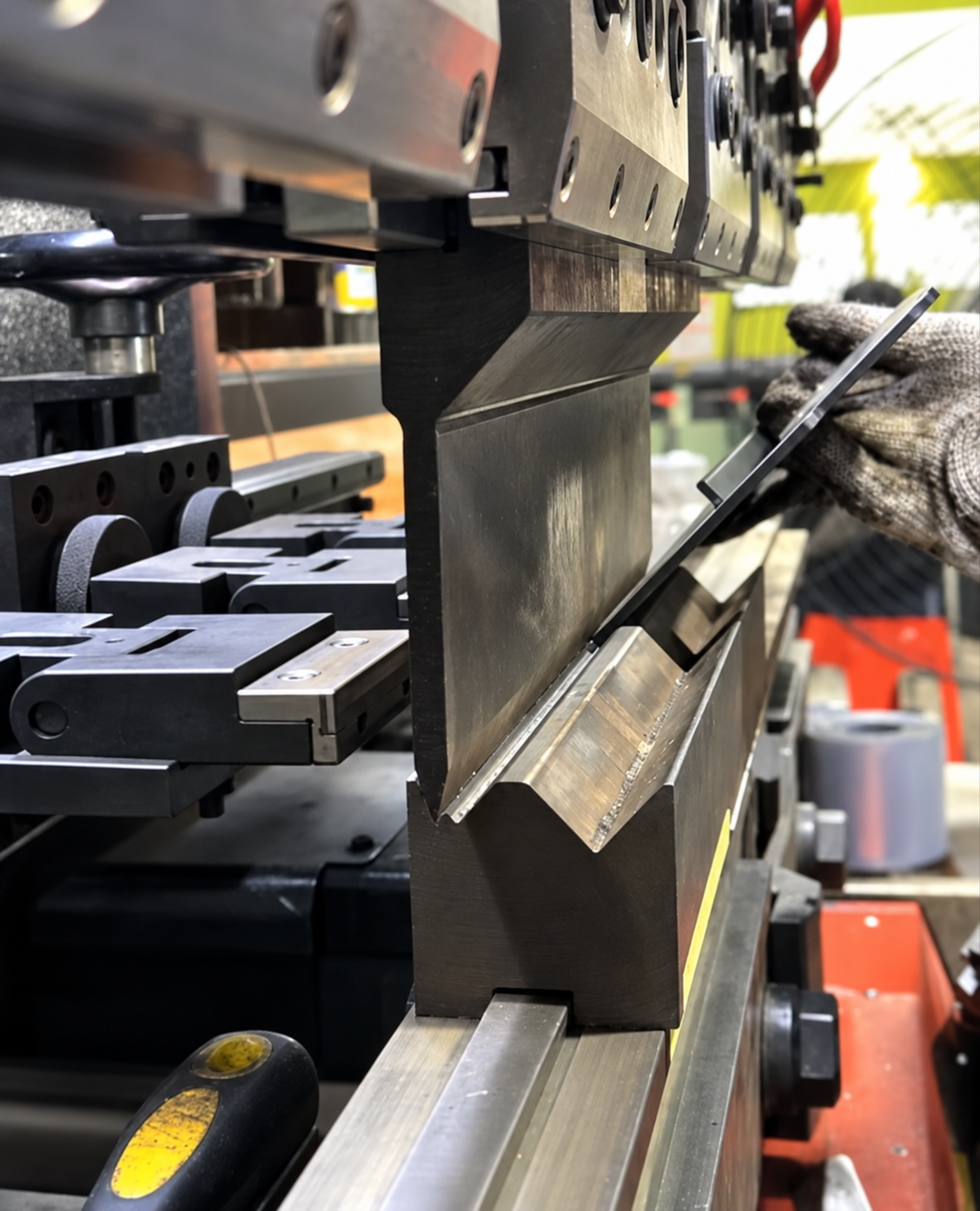
28° Press Brake Punch & 2V Lower Die
How to Match a 28° Acute-Angle Press Brake Punch with a 2V Lower Die? 28° Acute-Angle Press Brake Punch[…]
No responses yet